

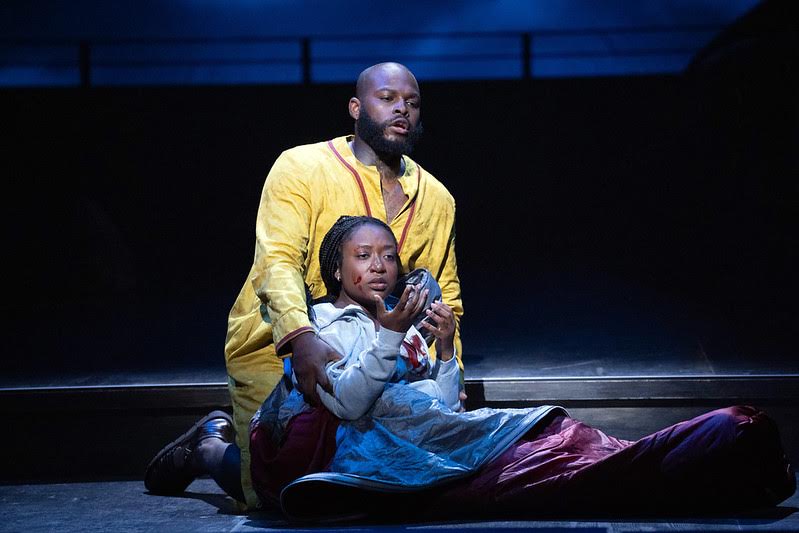
The Duke of Mantua is the sort of man your friends would tell you to avoid. Charming, powerful and apparently convinced that fidelity is somebody else’s problem. Naturally, Verdi gives him one of the most irresistible tunes in opera. There is a lesson in there somewhere about falling for a good voice and last night, Opera North brought this deeply unpleasant man and the people caught in his orbit to The Lowry. If opera is unfamiliar territory, the ingredients here won’t be. Attraction, jealousy, family secrets and a wealthy man who expects everyone else to deal with the consequences.
At the centre is Rigoletto, the court jester who earns his place by making others the joke. At home, he tries to shield his daughter Gilda from the very world he helps sustain. When she falls for the Duke, those two lives collide. His attempts to protect her become tangled up with his need for revenge.
What interests me is how difficult Verdi makes it to take a comfortable position on Rigoletto. He is cruel and loving, bullied and a bully. We can understand his fear for his daughter while questioning whether keeping her hidden has prepared her for anything at all. Loving someone and knowing what is best for them are, of course, two different things.
Femi Elufowoju Jr’s production places the story in a contemporary world of wealth and influence, exploring Rigoletto’s outsider status through Black experience. That gives the question of belonging a particular significance. He has access to the powerful, but access is no guarantee of acceptance.
For some LGBT+ audiences, that distinction may feel familiar: being welcome while you entertain, knowing when to laugh along, judging how much of yourself a room will tolerate. The production’s racial perspective deserves to be understood on its own terms, but it also opens up a wider question. What does it cost to keep the approval of people who do not quite regard you as their equal?
The three central performances were superb. Blake Denson’s Rigoletto and Leonardo Sánchez’s Duke gave us plenty to admire, even when their characters gave us plenty to object to. Denson had the difficult task of making us care about this deeply contradictory father, while Sánchez offered a persuasive reminder of why Gilda might fall for precisely the wrong man. This was an excellent evening for voices with Jasmine Habersham’s Gilda deserving particular praise. She was absolutely stunning in the moments when you most needed her to be. In Caro nome, the first-act aria in which Gilda dreams about the young man she has met, Verdi takes the voice high into delicate, intricate phrases and Habersham excelled. Her final scene with Denson brought that father-and-daughter relationship painfully into focus. Beautiful singing, and a character you cared about.
For anyone coming to the music for the first time, listen beyond the famous La donna è mobile. As a musician, the quartet in the final act is the passage I would particularly point newcomers towards. Four people experience the same situation quite differently, and Verdi lets us hear all of them at once. Desire, amusement, hurt and anger share the music. You don’t need to analyse the score to follow it; the voices do the explaining.
Credit to Opera North and The Lowry for making room for productions that invite fresh audiences into these works. It is sung in Italian with English subtitles, so there is no homework required. With these three leads, there was every reason to give it a go, and in Habersham’s Gilda, someone whose singing will stay with me.
Canal St Card holder savings at the bar too
You may arrive knowing one tune. There is considerably more trouble waiting behind it.
Dean Thomas-Lowde for Canal Street Media